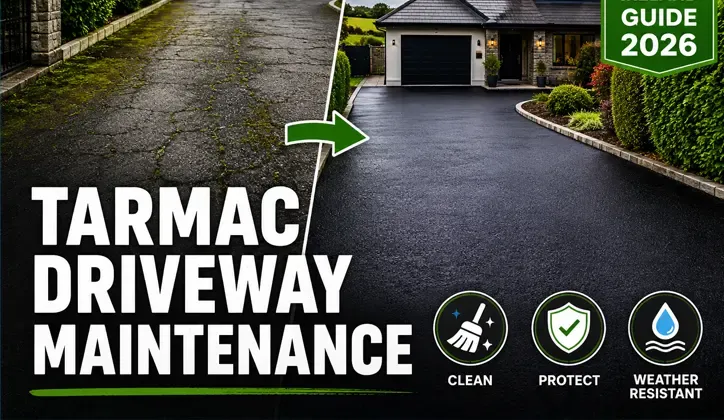
7 Signs Your Tarmac Driveway Needs Replacing in Ireland
7 Signs Your Tarmac Driveway Needs Replacing in Ireland | Expert Guide
A tarmac driveway adds to the beauty and functionality of your home. However, over time and with constant use, it is natural for it to deteriorate. Many homeowners only think about repairs when they see small cracks or holes. But in some cases, repeated repairs are just a waste of money. Due to Ireland's wet and damp weather and severe winters, damage to driveways often goes beyond the surface. When the main foundation or sub-base of a driveway is damaged, there is no permanent solution other than a new driveway replacement.
If your tarmac driveway is cracked extensively, has potholes in the same spot repeatedly, has water pooling after rain, or is over 20 years old, it is most cost-effective and wise to replace it completely rather than having to repair it repeatedly.
Repair, Resurface or Replace? Here's How to Decide
To determine which solution is right for your driveway, it's important to understand exactly how serious the damage is. Is the damage just superficial or to the interior structure? The table below will help you make the right decision.
New Paragraph
| Features / Status | Patch Repair | Resurfacing | Complete replacement |
|---|---|---|---|
| Cost level | Low | Medium | High |
| Durability | 1 to 3 years | 5 to 8 years | 15 to 20 years |
| Structural problems | There is no solution | Partial or temporary solution | Completely permanent solution |
| When is it suitable? | For small and isolated cracks or a small hole | The driveway has a solid foundation but the surface is discolored or eroded | The sub-base is broken, there are drainage problems and extensive cracks |
Many people think that resurfacing (laying a new layer over old tarmac) will solve all problems. But if the sub-base underneath is weak, the resurfacing will not last even a few months. The Irish weather exacerbates this problem even more quickly. If you try to save a few hundred euros on a small repair today, you could end up spending four to five times as much and replacing the entire driveway in the next two years.
Book our Free Driveway Assessment (Free Quote) today to accurately assess the current condition of your driveway and receive professional advice.
7 Signs Your Tarmac Driveway Needs Replacing
Based on Milestone Driveways' 20 years of practical experience, here are 7 clear signs that your driveway is beyond repair and it's time to replace it completely.
1. Large or Alligator Cracks Are Spreading
When cracks in a driveway look like crocodile skin or small webs, they are called "alligator cracks" in the construction industry. This is a serious warning sign. It means that the sub-base (foundation layer) beneath the driveway has lost its load-bearing capacity.
When heavy vehicles pass over it and the ground below is unstable, the tarmac begins to break down like this. In this situation, there is no point in repairing the cracks (Driveway Repairs) or sealing, because the main structure inside has collapsed.
2. Potholes Keep Returning
If you just repaired a pothole in your driveway, and a few months later another large pothole appears in or near the same spot, you know the problem is deeper.
When water collects under the tarmac and washes away the sand and gravel in the sub-base, a void is created. When the pressure of a vehicle from above is applied, the area collapses and becomes a pothole. Recurring potholes indicate that your driveway has suffered structural damage.
3. Water Pools After Rain
Rainfall is a daily occurrence in Ireland. But if your driveway is left with puddles or puddles after a rainstorm, it could be a sign that there is a major problem with the proper slope or drainage system.
It is very important to have a proper slope for water drainage during the installation of tarmac driveways. When water collects, it weakens the binder inside the tarmac. Especially in winter, when this accumulated water freezes, it expands and cracks the tarmac from the inside, which is known as the freeze-thaw cycle.
4. Edges Are Crumbling
If the edges around the driveway start to loosen and crumble, it is a threat to the entire driveway. If the edges of a tarmac driveway are not secured with strong curbing or proper support, they will start to crack over time. Once the edges start to crack, the cracks will quickly spread inward and destroy the stability of the entire driveway.
5. Your Driveway Is 15–20+ Years Old
A properly installed high-quality tarmac driveway will typically last 15 to 20 years. However, if the driveway is regularly subjected to heavy traffic or lacks maintenance, its lifespan can be further reduced. If your driveway is over 15 years old and is experiencing regular problems, it may be more cost-effective to replace it entirely rather than spending money on repairs every year.
6. Sinking, Ruts or Uneven Areas
If any part of the driveway is sagging downwards or if there are long holes or ruts where the wheels of the car regularly fall, this is clear evidence of sub-base failure. If the soil below was not properly compacted or hardened during the construction of the driveway, or if a vehicle heavier than the soil can support is placed on it, the driveway will sag. It is impossible to straighten these sagging sections; the only solution is to dig out the soil and create a new solid base.
7. Weeds Grow Through the Surface
When grass, moss or weeds start to grow through small cracks in the tarmac, many people clean it off with a simple weed killer. But the problem is that the roots of these plants quickly spread under the tarmac and loosen the tarmac layer from the inside. Moss growth is very common in the Irish climate, which causes long-term damage to the tarmac. If the cracks are so deep that weeds are constantly coming up from below, then it is clear that the protective layer of the driveway has been destroyed.
Quick Self-Inspection Checklist for Irish Homeowners
Below is a quick checklist to help you check the condition of your driveway yourself. Take a look at your driveway today and check for these things:
- [ ] Crack type: Are the cracks 1-2 single lines, or are they spread like a web across the entire driveway? (If they are web-like, they will need to be replaced)
- [ ] Waterlogging: Is there any water pooling in any part of the driveway even after 30 minutes of rain? (If yes, there is a drainage or slope problem)
- [ ] Hole repetition: Have you had to repair potholes in the same place multiple times in the past year?
- [ ] Edge condition: Is the border or edging around the driveway loosening and breaking?
- [ ] Surface evenness: Look straight ahead at the driveway, is there any part that is sagging or uneven?
If 3 or more boxes on this checklist are ticked, it's time to resurface your driveway. Milestone Driveways has been providing driveway replacement and repair services throughout Ireland for over 20 years with a very good reputation. You can visit our Projects page to view various county-based case studies based on our experience and to verify the quality of the work.
Tarmac Repair vs Replacement Costs in Ireland
Budget plays a big role in the decision to replace a driveway. Below is a general idea based on current market prices in Ireland:
- Minor repairs or patching: Repairs to a hole or crack can typically cost between €150 and €500 (depending on the extent of the damage).
- Resurfacing: If only the top layer is being replaced, it can cost around €25 to €45 per square meter (m²).
- Full Replacement: Removing the entire old tarmac, fixing the sub-base and laying new tarmac can typically cost between €55 and €90+ per square meter.
Long-term calculations: If you spend €400-€500 on driveway repairs every year, you'll end up spending around €2,500 in 5 years, and your driveway will still be old and unsafe. On the other hand, a complete replacement at the right cost will give you peace of mind for the next 20 years, which will also increase the value of your property.
If you are looking for a cost-effective and attractive alternative to tarmac, you can view our excellent collection of stone chips on our Tar and Chippings page, or read our blog for the exact cost in Ireland: Tar and Chip Driveway Cost Guide.
What Happens During a Full Tarmac Driveway Replacement?
The process of building a new driveway is quite systematic and involves several important steps. To ease the mental stress of our customers, we have summarized each step of our work below:
[Site Survey and Planning] ➔ [Excavation and Removal of Old Tarmac] ➔ [Sub-base Preparation]
↓
[Finishing and Rolling] ➔ [Laying New Tarmac Layer] ➔ [Proper Drainage and Slope Creation]
- Site survey and slope determination: First, our experts inspect your driveway area and determine the proper slope for water drainage.
- Excavation and removal of old layers: With the help of modern equipment, the old damaged tarmac and damaged sub-base are completely dug out and removed to a safe location.
- Sub-base Preparation: This step is the most important. A strong and sturdy base is created with high-quality crushed stone and compacted with heavy rollers.
- Drainage Installation: In accordance with local drainage regulations in Ireland, necessary channels or gullies are installed to ensure that rainwater drains away quickly.
- Tarmac laying and finishing: Hot tarmac (Bitumen & aggregate mix) at the correct temperature is laid perfectly and applied with heavy rollers to give a smooth and long-lasting finish.
FAQs about Signs of Tarmac Driveways in Ireland
How long does a tarmac driveway last in the Irish weather?
A tarmac driveway built by a professional company and with the correct sub-base will generally last 15 to 20 years or more in Ireland's humid climate. Regular maintenance will extend its lifespan even further.
Is it possible to lay new tarmac directly over an old tarmac driveway?
Yes, it's called resurfacing. But it's only possible if the underlying sub-base of your driveway is completely intact and strong. If the sub-base has cracked or is about to crack, putting a new layer on top of the old one will cause it to crack again within a few months. Check out our detailed guide to the pros and cons of tarmac vs block paving: Tarmacadam vs Block Paving Comparison.
Is tarmac more cost-effective than block paving?
Generally yes. For larger driveways, installing tarmac is much more cost-effective than block paving and can be done much faster. It provides a smooth and joint-free surface, so there is no chance for weeds to grow unless they crack.
How long after the construction of a new tarmac driveway can a car be driven on?
Generally, after laying new tarmac, you should allow 24 to 48 hours, depending on the weather. On hot days, the tarmac may take a little longer to harden. It is best to avoid moving heavy vehicles or wheels until it is completely hardened.
Can pressure washing damage tarmac?
High-psi pressure washers can loosen the bitumen layer on the tarmac, especially if the driveway is older. It is safest to use a gentle water spray and a special moss killer to clean the driveway. We also help with boundary protection along with the driveway, which you can find out more about on our Fencing Services page.
The decision is yours, the cooperation is ours.
If your driveway is showing any of the above signs, don’t waste your money on repairs. Milestone Driveways has been serving the South-East of Ireland, particularly Wexford and Waterford, with a long-term warranty on all our work, giving you complete peace of mind.
Contact our experienced team today to restore the beauty and safety of your home. For a free inspection and quote on your driveway, simply fill out our Contact Us form or give us a call. We will give your driveway a long-lasting and attractive new look!